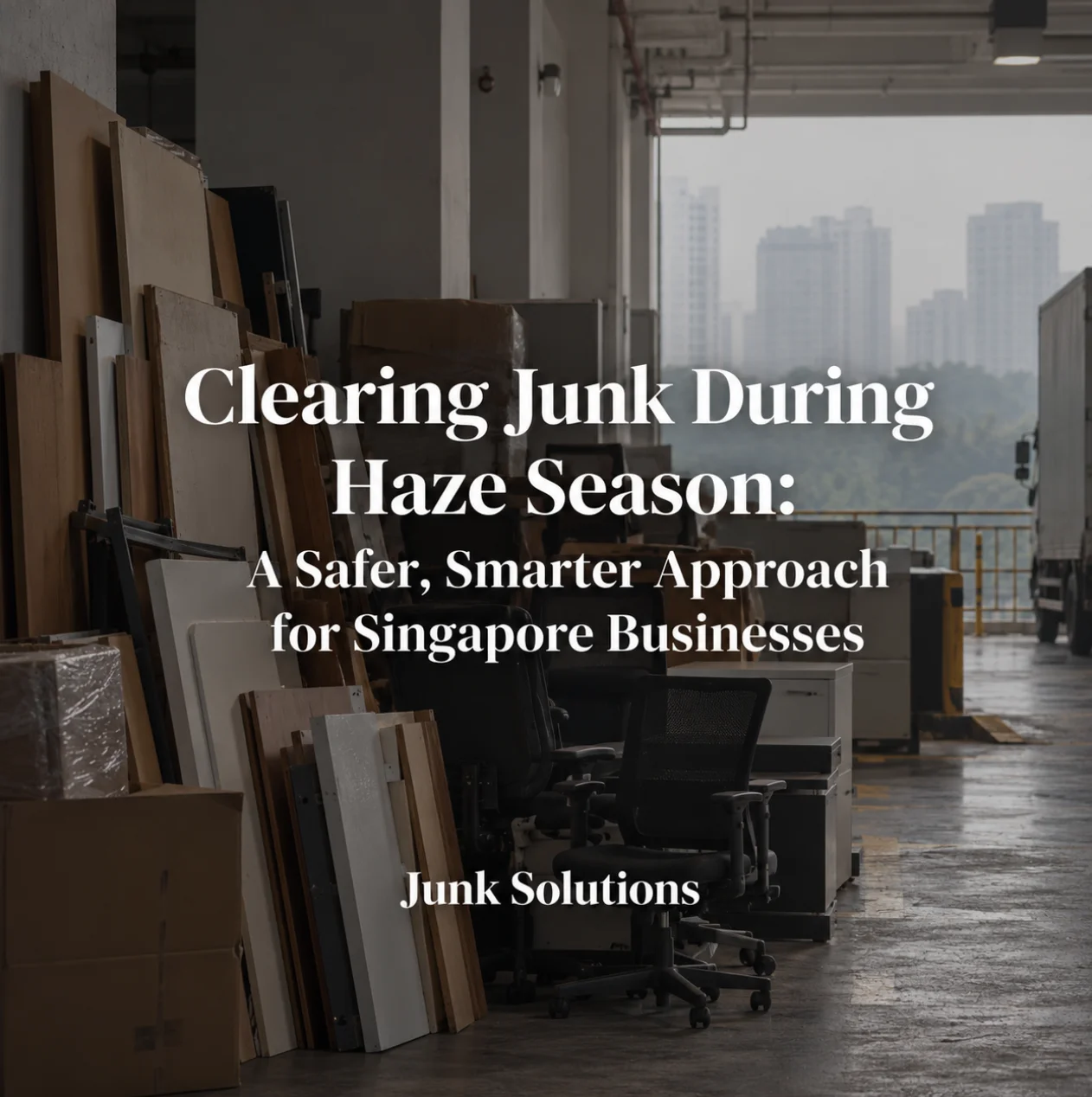
Haze is back in Singapore, and it is sticking around. On 4 September, the 24-hour PSI crossed into the unhealthy range for the first time since October 2023. It then peaked at 192 in the central region on 9 October, the highest reading of 2026 so far.
The Meteorological Service Singapore does not expect the dry season to ease until late October or early November, later than in the past two years. That means more hazy days ahead.
Business does not stop for the haze. Office moves, tenancy handovers and renovation clear-outs still have fixed deadlines. But hauling furniture down loading bays and into lorries is exactly the kind of strenuous outdoor work the authorities advise against when air quality drops.
This guide covers the health hazards, the safety risks and the practical way to keep your disposal plans on track without putting your team at risk.
The health hazards of clearing junk in the haze
A clearance is physical work. Staff carry heavy items, climb stairs and move in and out of loading bays for hours. When you breathe harder, you take in more haze particles.
Here is what that means in practice:
- Breathing in fine particles. Haze carries PM2.5, fine particles small enough to reach deep into the lungs. Heavy lifting makes people breathe faster and deeper, which increases exposure.
- Higher risk for some staff. NEA advises that the elderly, pregnant women and people with chronic heart or lung conditions minimise or avoid outdoor exertion during unhealthy haze.
- Fatigue and discomfort. Haze can bring on headaches, sore throats and tiredness. Masks help, but wearing one during heavy work is uncomfortable and tiring.
- Dust on top of haze. Old furniture, carpets and long-stored boxes release their own dust when moved. Combined with haze, that adds up quickly.
A quick clear-up by your office team might seem harmless. In the current conditions, it carries real health costs.
Safety risks and what MOM expects of employers
Under the Workplace Safety and Health (WSH) Act, employers are responsible for protecting staff from haze. MOM’s guidelines on protecting employees from haze set out how much outdoor work is advisable at each PSI level.
| 24-hour PSI | Healthy employees | Elderly or pregnant employees | Employees with chronic lung or heart disease |
|---|---|---|---|
| 101 to 200 (Unhealthy) | Reduce prolonged or strenuous outdoor work | Minimise prolonged or strenuous outdoor work | Avoid prolonged or strenuous outdoor work |
| 201 to 300 (Very Unhealthy) | Avoid prolonged or strenuous outdoor work | Minimise outdoor work | Avoid outdoor work |
| Above 300 (Hazardous) | Minimise outdoor work | Avoid outdoor work | Avoid outdoor work |
Source: GoBusiness Haze Advisory for Businesses
MOM also expects employers to carry out risk assessments, rotate staff to shorten outdoor exposure, schedule indoor rest breaks and provide suitable masks when strenuous outdoor work cannot be avoided. Above PSI 400, non-essential work should be deferred. Companies that fail to manage these risks can face enforcement under the WSH Act, including stop-work orders and fines.
On top of the health rules, haze adds practical safety risks to any clearance:
- Poor visibility at loading bays and car parks, where lorries reverse and staff carry bulky items.
- Rushed work, as teams hurry to finish outdoors and cut corners on safe lifting.
- Fatigue, which raises the chance of dropped items, strains and slips.
Why outsourcing disposal makes sense during haze
When PSI is high, every hour your staff spend hauling furniture is an hour of exposure you have to justify. Handing the job to a professional disposal team solves several problems at once.
- Your staff stay indoors. Your team keeps working from the office or home while the clearance happens, in line with MOM’s advice to reduce outdoor work.
- The job finishes faster. A trained crew with the right equipment clears in hours what an office team might take days to do. Shorter jobs mean less time outside.
- Less paperwork for you. You spend less time on risk assessments, mask supplies and rest-break rosters for a one-off job outside your staff’s normal work.
- Deadlines stay on track. Your lease handover or renovation date does not move because of the haze. A dedicated team keeps it on schedule.
- Proper disposal, no shortcuts. Bulky waste goes through proper channels instead of piling up in corridors waiting for a clear day.
How Junk Solutions plans clearances around the haze
Junk Solutions handles office clearances, commercial disposal and large-scale removals for Singapore businesses. During haze season, we plan each job with air quality in mind.
- We check the forecast. We review NEA’s daily haze advisory when planning your clearance date and time.
- We plan for efficiency. We assess the job upfront, so the right crew size and vehicle arrive and the work finishes in as few hours as possible.
- We work indoors first. We gather, dismantle and stage items inside before moving them out, so outdoor loading time stays short.
- We stay flexible. If air quality turns hazardous, we work with you to adjust timing while keeping your deadline in view.
- We clear it in one go. Furniture, equipment, appliances and bulky junk all leave together, with proper disposal and recycling where it makes sense.
You get a clear space and a met deadline, and your team never has to step into the haze.
Your haze-season clearance checklist
Use this list before you book any clearance while the haze lasts.
- Check NEA’s 24-hour PSI and daily haze forecast before fixing a date.
- Book early, so you can pick a better-air day without missing your deadline.
- List every item to be cleared, with photos, so the crew arrives ready.
- Book the loading bay or service lift for the shortest possible window.
- Keep vulnerable staff away from the clearance area.
- Close windows and doors near the work area to limit haze and dust indoors.
- Confirm your disposal company can adjust timing if PSI turns very unhealthy.
- Have one person on site to direct the crew, ideally from indoors.
Frequently asked questions
Should I postpone my office clearance because of the haze?
Not necessarily. At unhealthy PSI levels, MOM advises reducing prolonged or strenuous outdoor work, not stopping all work. A professional team that finishes quickly and plans around the forecast keeps exposure low. If PSI turns hazardous, talk to your disposal company about adjusting the timing.
Which haze reading should I check before a clearance?
Use NEA’s 24-hour PSI for planning, as MOM’s guidelines are based on it. On the day itself, check the one-hour PM2.5 reading too, since air quality can change within hours.
Can my own staff help with the clearance during haze?
They can, but you are responsible for their safety under the WSH Act. That means risk assessments, masks where needed, rest breaks and keeping vulnerable staff away. Outsourcing the heavy lifting is usually simpler and safer.
How long will the haze last?
The Meteorological Service Singapore expects the dry season to end around late October or early November 2026. Until then, plan for more hazy days.
Plan a safer clearance with Junk Solutions
The haze will clear eventually. Your deadlines won’t wait for it.
Send us your item list, photos and target date. We’ll plan a fast, efficient clearance around the conditions, so your team stays indoors and your project stays on track. Get a quote from Junk Solutions