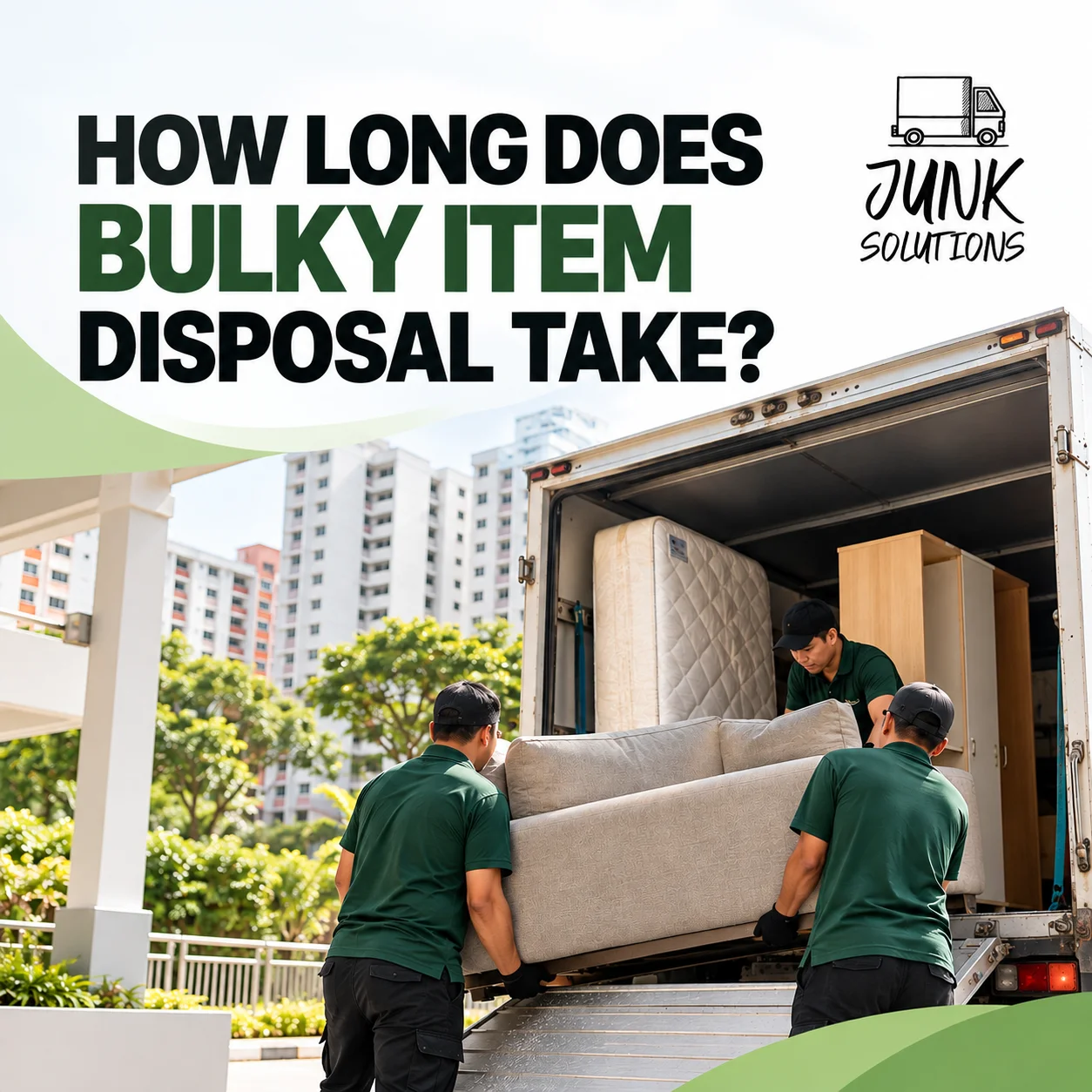
Clearing bulky items can take anywhere from a short collection visit to several hours, depending on how much you need to remove. Whether you’re disposing of an old sofa in your HDB flat, clearing furniture before a BTO move, or removing office equipment during a relocation, the time required depends on more than just the number of items.
A single wardrobe may take longer to remove than several dining chairs. Items that require dismantling, narrow access routes, and lift booking restrictions can also add time to the process.
If you’re planning a furniture disposal or junk removal service in Singapore, understanding these factors can help you schedule your collection and prepare your space.
In this guide, Junk Solutions explains how long bulky item clearance may take based on quantity, what can affect the timeline, and how you can prepare for a smoother removal.
How Long Does It Take to Clear Bulky Items Based on Quantity?
The time required to clear bulky items depends on their size, weight, accessibility, and handling requirements. The estimates below serve as general planning guidelines for the on-site removal process, rather than guaranteed collection durations.
Estimated Clearing Time by Quantity
| Quantity and type of items | Examples | Indicative on-site clearing time |
|---|---|---|
| 1–3 small or medium items | Dining chairs, small tables, bedside cabinets | 15–30 minutes |
| 1–3 large bulky items | Sofa, mattress, wardrobe | 30–60 minutes |
| 4–8 mixed bulky items | Beds, cabinets, tables, and chairs | 45–90 minutes |
| 9–15 bulky items | Multiple furniture pieces from a flat or small office | 1–3 hours |
| 16–30 mixed items | Furniture and equipment from several rooms or an office | 2–4 hours |
| More than 30 items | Large household clearance or commercial furniture removal | Half a day or longer |
Note: These are illustrative estimates for straightforward on-site removal. They are not measured Junk Solutions service averages. Actual durations may be shorter or longer depending on item dimensions, weight, dismantling, manpower, access conditions, and the removal route. Large commercial clearances may require a site assessment before the team can provide a more reliable estimate.
1. Clearing 1–3 Bulky Items: Around 15–60 Minutes
If you only have a few items to dispose of, the removal may take less than an hour when the items are ready for collection and the access route is clear.
For example, removing an old mattress, a small cabinet, and a dining table may be relatively straightforward if the team can move everything directly to the collection vehicle.
However, a large wardrobe or sectional sofa may take longer because the team needs to manoeuvre it through doorways, corridors, and lifts.
Best for: Residents replacing furniture, tenants preparing for a move, and households decluttering a few large items.
2. Clearing 4–8 Bulky Items: Around 45–90 Minutes
A larger collection requires more lifting, carrying, and coordination. The team may need to organise the removal sequence to prevent items from blocking one another.
For example, clearing a typical bedroom and part of a living room could involve removing a bed frame, mattress, wardrobe, sofa, and several smaller furniture pieces.
The removal may take longer if the team needs to dismantle furniture or make several trips between the unit and the collection vehicle.
Best for: Households renovating a room, replacing several furniture pieces, or preparing for a move.
3. Clearing 9–15 Bulky Items: Around 1–3 Hours
Once you have more than a few bulky items, the layout of the property becomes increasingly important.
A collection involving multiple cabinets, tables, chairs, mattresses, and appliances requires careful coordination. The team may also need to dismantle selected items before moving them out.
For HDB flats and condominiums, the availability of service lifts, corridor space, and suitable loading areas can affect how efficiently the team works.
Best for: Families moving house, tenants clearing an entire unit, and small offices replacing furniture.
4. Clearing 16–30 Bulky Items: Around 2–4 Hours
Larger clearances usually require more planning, particularly when the items are spread across multiple rooms or floors.
For an office, this could include workstations, office chairs, storage cabinets, pantry appliances, and unwanted equipment.
The team may need to separate the removal into stages, dismantle larger furniture, and coordinate the movement of items through shared corridors or service lifts.
For commercial premises, confirm any building management requirements before the collection date.
Best for: Office relocations, commercial renovations, and larger residential clearances.
5. Clearing More Than 30 Bulky Items: Half a Day or Longer
Large-scale clearance jobs can take several hours or extend across multiple sessions.
For example, an office relocation may involve dozens of workstations, partitions, cabinets, and electronic equipment. A large household clearance may involve furniture from every room, including items stored in spare rooms or storage areas.
The total duration depends on the volume of items, the number of workers and vehicles required, dismantling needs, and the building’s access arrangements.
For these jobs, an on-site assessment is often the best way to establish a realistic schedule.
Best for: Large offices, commercial facilities, landlords preparing properties for new tenants, and full-house clearances.
What Factors Affect Bulky Item Removal Time?
The number of items gives you a starting point, but several other factors can influence the actual duration.
1. Size and Weight of the Items
Not all bulky items require the same amount of handling.
A dining chair is relatively easy to carry, while a large solid-wood wardrobe, piano, or commercial machine may require additional manpower and specialised handling arrangements.
Heavy or awkward items can take longer to move safely, even when the collection involves only one or two pieces.
2. Whether the Items Need Dismantling
Some furniture can be removed as it is, while other pieces need to be dismantled before the team can move them through the available space.
Common examples include:
- Large wardrobes
- Bed frames
- Modular office workstations
- Large tables
- Furniture assembled in tight spaces
If you know that an item needs dismantling, mention it when requesting a quotation. This allows the team to assess the tools, manpower, and time required.
Built-in furniture may require a different scope of work from ordinary movable furniture, so confirm this before booking.
3. Access to the Property
Singapore’s high-rise residential and commercial buildings can present different access requirements.
For example, removing a sofa from a ground-floor landed property may involve a shorter route than removing the same sofa from a high-floor condominium.
The team may need to account for:
- Lift dimensions and availability
- Staircases and narrow corridors
- Doorway clearance
- Distance to the loading bay
- Parking and vehicle access
- Restrictions imposed by building management
If the item cannot fit into the lift, the team may need to assess alternative removal arrangements.
4. Number of Workers and Vehicles
A larger team may complete some jobs faster, but the number of workers needed depends on the items and site conditions.
Large or heavy items may require several workers to move safely. Bigger clearances may also require additional vehicle capacity or multiple trips.
The team should assess the scope before confirming the manpower and transport arrangements.
5. Building Management and Collection Restrictions
Condominiums, office buildings, and commercial facilities may require advance arrangements for bulky item removal.
These may include service lift reservations, lift padding, approved collection hours, loading bay bookings, and contractor registration.
For HDB residents, Town Council bulky item removal services may have their own booking requirements, item limits, and collection schedules.
Check the relevant arrangements before your collection date to avoid unnecessary delays.
How to Prepare for a Faster Bulky Item Clearance
You can help the removal team work more efficiently by preparing a few details before collection.
1. Make a List of Items for Removal
List every item you want to dispose of, including the quantity and approximate size where possible.
Instead of saying you have several pieces of furniture, specify that you have two wardrobes, one queen-size bed frame, one mattress, and four dining chairs.
This gives the team a clearer understanding of the job.
2. Send Photos Before Requesting a Quote
Photos help the team assess the size, condition, and accessibility of your items.
Take pictures from different angles, especially for large furniture, built-in structures, and awkwardly positioned equipment.
If possible, include photos of the corridor, staircase, lift, or loading area when access may be challenging.
3. Clear the Removal Route
Move loose belongings, boxes, and other obstacles away from the path between the items and the exit.
For office clearances, make sure employees have removed their personal belongings and that the team can access the furniture without disrupting ongoing operations.
You do not need to move heavy furniture yourself. Leave the lifting and handling to the removal team.
4. Confirm Lift and Loading Arrangements
If you live in a condominium or work in a commercial building, check whether management requires advance approval.
Reserve the service lift if necessary and confirm the permitted collection window.
For HDB flats, check with your Town Council if you plan to use its bulky item removal service. The eligibility rules, number of items accepted, and booking requirements vary by estate.
5. Confirm Whether Dismantling Is Required
Identify items that may not fit through the doorway or into the lift in their current form.
Tell the team if any furniture requires dismantling or if you need help removing built-in fixtures.
Confirming these details in advance can reduce unexpected work on collection day.
Should You Use a Town Council Service or Hire a Professional Junk Removal Company?
The best option depends on the number and type of items you need to remove, how quickly you need them cleared, and whether you require additional handling.
In Singapore, some Town Councils offer complimentary bulky item removal to eligible HDB residents, subject to specific conditions. However, the service may not cover dismantling, built-in furniture, very heavy items, house-moving services, or commercial clearances.
For example, Tanjong Pagar Town Council and Aljunied-Hougang Town Council publish their own eligibility and booking requirements. Residents should check the latest rules for their respective estates.
A professional junk removal company may be more suitable when you need to remove several items, handle difficult access, arrange dismantling, or clear a commercial space.
| Consideration | Town Council service | Professional junk removal |
|---|---|---|
| Cost | May be complimentary for eligible HDB residents, subject to conditions | Charges apply based on the job and service scope |
| Item limits | Often subject to monthly or per-appointment limits | Depends on the company’s capacity and the agreed scope |
| Dismantling | Commonly excluded from basic services | May be available upon request |
| Heavy or specialised items | Often excluded | Must be assessed and confirmed in advance |
| Commercial clearance | Generally not covered by residential services | Suitable services may be available |
| Scheduling | Follows the Town Council’s available collection slots | Depends on the company’s availability and booking arrangements |
If you need to clear bulky items from a home or commercial property, Junk Solutions can assess your requirements and recommend a suitable removal arrangement.
Book Your Bulky Item Removal with Junk Solutions
Whether you’re disposing of a single sofa or clearing an entire office, knowing what needs to go helps you plan the collection more effectively.
At Junk Solutions, we handle bulky item disposal, furniture removal, dismantling, and office clearance across Singapore. Our team can assess your items and access requirements to help determine the appropriate removal arrangements.
To request a quotation, share the following details:
- Your location in Singapore
- A list of items and their quantities
- Photos of the items
- Any access restrictions or dismantling requirements
- Your preferred collection date
Need to clear bulky items?
Contact Junk Solutions at +65 8857 0027 or email info@junks.sg to discuss your requirements.
Frequently Asked Questions
1. How long does it take to dispose of one bulky item in Singapore?
Removing one straightforward bulky item may take approximately 15–30 minutes once the team starts handling it. Larger items, such as wardrobes or heavy appliances, may take longer if they require dismantling or difficult manoeuvring.
These are general planning estimates, not guaranteed service durations.
2. How long does it take to clear an entire HDB flat?
The duration depends on the number of items, the size of the flat, access conditions, and whether furniture needs dismantling. A small collection may take less than an hour, while clearing several rooms can take a few hours or longer.
For a more reliable estimate, prepare an item list and share photos before booking.
3. Can bulky items be removed on the same day?
Same-day collection may be available depending on the service provider’s schedule, location, manpower, and the size of the job. Contact Junk Solutions to check availability and confirm your collection arrangements.
4. Does dismantling furniture increase the clearing time?
Yes. Dismantling can add time because the team needs to assess the item, use the appropriate tools, and remove its components safely. Built-in furniture and complex fixtures may require additional work.
Mention dismantling requirements when requesting your quotation.
5. How long does office furniture clearance take?
A small office clearance involving a few desks and chairs may take less time than a large office clearance involving multiple workstations, partitions, cabinets, and equipment.
The total duration depends on the number of items, floor access, dismantling requirements, manpower, and loading arrangements. An on-site assessment may be necessary for larger jobs.
6. Do I need to book a lift before bulky item removal?
If you live in a condominium or work in a building with shared service lifts, management may require advance reservations or specific collection arrangements. Check the building’s rules before confirming your booking.
For HDB flats, the team should assess whether the items can fit safely through the available lift or require another removal route.
7. Can I leave bulky items in my HDB corridor before collection?
Do not leave bulky items in common areas before confirming the collection arrangements. Items left in corridors or other shared spaces can obstruct access and emergency escape routes.
Follow your Town Council’s instructions and arrange for collection at the appropriate time.
8. What information should I provide to get an accurate removal estimate?
Provide your location, a list of items, their quantities, photos, and details about access conditions. Mention any heavy items, built-in fixtures, dismantling requirements, or building management restrictions.
These details help the service provider assess the job and recommend suitable arrangements.
9. Is professional junk removal faster than Town Council collection?
Not necessarily in every situation. A professional service may offer more flexible arrangements or additional handling options, depending on availability and the scope of work. Town Council services follow their own booking schedules and eligibility rules.
Compare the available options based on your items, timeline, and service requirements.
10. How can I make bulky item removal faster?
Prepare an accurate item list, send photos in advance, clear the removal route, and confirm lift and loading arrangements. Inform the team about any dismantling requirements before collection day.
Good preparation helps reduce avoidable delays and makes it easier to plan the removal.
Editorial note: The clearing times in this article are illustrative estimates for customer planning, not figures published by NEA, Town Councils, or verified Junk Solutions operational data.